

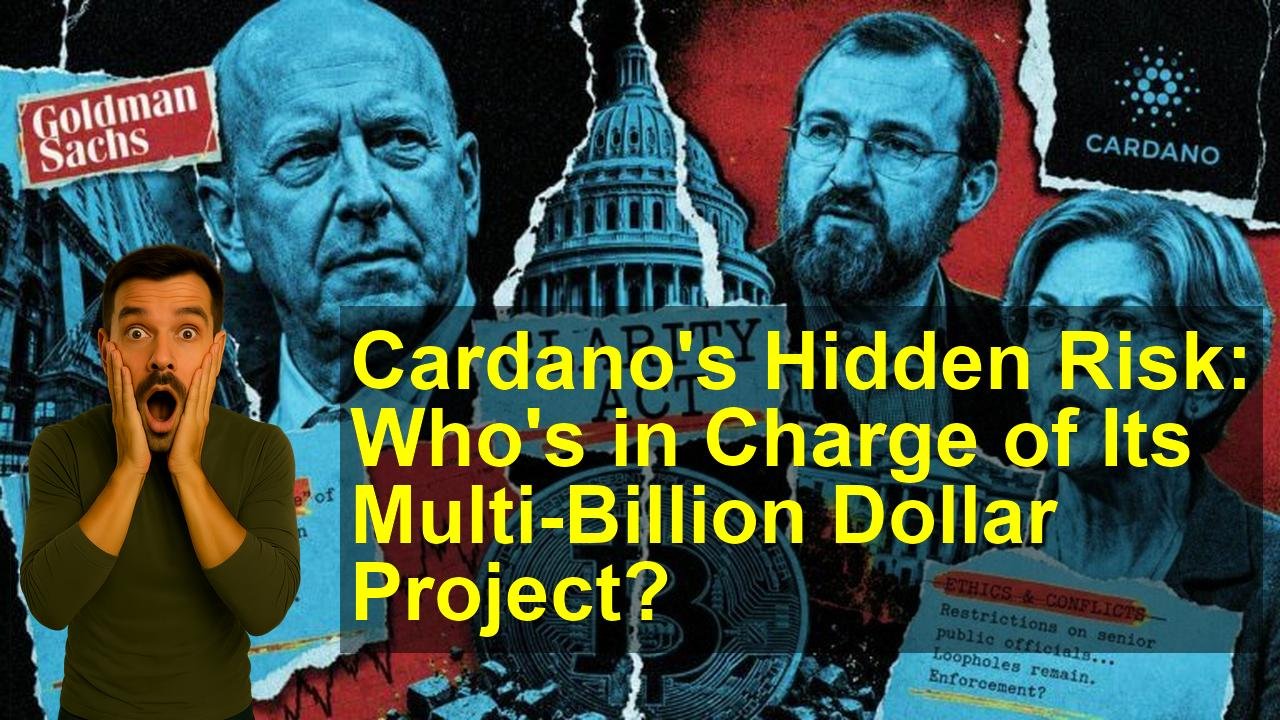
Cardano founder Charles Hoskinson has stated that he lacks control over the project's treasury and cannot act as its CEO, sparking questions about who is accountable for the project's growth and development.
Review Highlights
- Hoskinson claims he cannot run Cardano like a CEO due to limited control over the treasury.
- The project's treasury is managed by delegated representatives (DReps) and the Constitutional Committee.
- Recipients and administrators are responsible for delivering and overseeing funded work, but accountability for the project's growth remains unclear.
Cardano's Governance Structure
Cardano's treasury is managed by delegated representatives (DReps), who approve spending, and the Constitutional Committee, which checks constitutionality. Recipients and administrators are responsible for delivering and overseeing funded work.
Hoskinson's comments have raised questions about who is accountable for the project's growth and development. The project's governance structure is designed to distribute power among various stakeholders, but this has also created confusion about who is ultimately responsible.
Hoskinson's Role in Cardano
Hoskinson has stated that he lacks control over the project's treasury and cannot act as its CEO. This has sparked debate about his role in the project and whether he is truly accountable for its growth.
Hoskinson's comments have been met with skepticism by some, who argue that he is trying to shift blame for the project's slow growth. Others have defended him, saying that he is being transparent about the project's governance structure.
Industry Context
Cardano's governance structure is not unique in the cryptocurrency space. Many projects have similar structures, which are designed to distribute power among various stakeholders. However, this has also created challenges in terms of accountability and decision-making.
The debate over Hoskinson's role in Cardano has implications for the broader cryptocurrency industry. It highlights the challenges of governance and accountability in decentralized projects, and the need for clear decision-making processes.
What to Watch Next
The debate over Hoskinson's role in Cardano is likely to continue in the coming weeks and months. Investors and stakeholders will be watching closely to see how the project's governance structure evolves and how Hoskinson's role is defined.
The project's growth and development will also be closely watched. Cardano's slow growth has been a major concern for investors, and any changes to the project's governance structure or Hoskinson's role could have significant implications for the project's future.
Common Buyer Questions
What is the role of delegated representatives (DReps) in Cardano's treasury?
DReps are responsible for approving spending and managing the project's treasury. They play a crucial role in the project's governance structure.
What is the Constitutional Committee's role in Cardano's governance structure?
The Constitutional Committee is responsible for checking constitutionality and ensuring that proposals comply with the project's constitution. It plays a key role in the project's decision-making process.
Have a news tip, press statement, or correction request? Reach the DealMav Newsroom or review our Editorial Standards & Corrections Policy.





Leave a Reply