
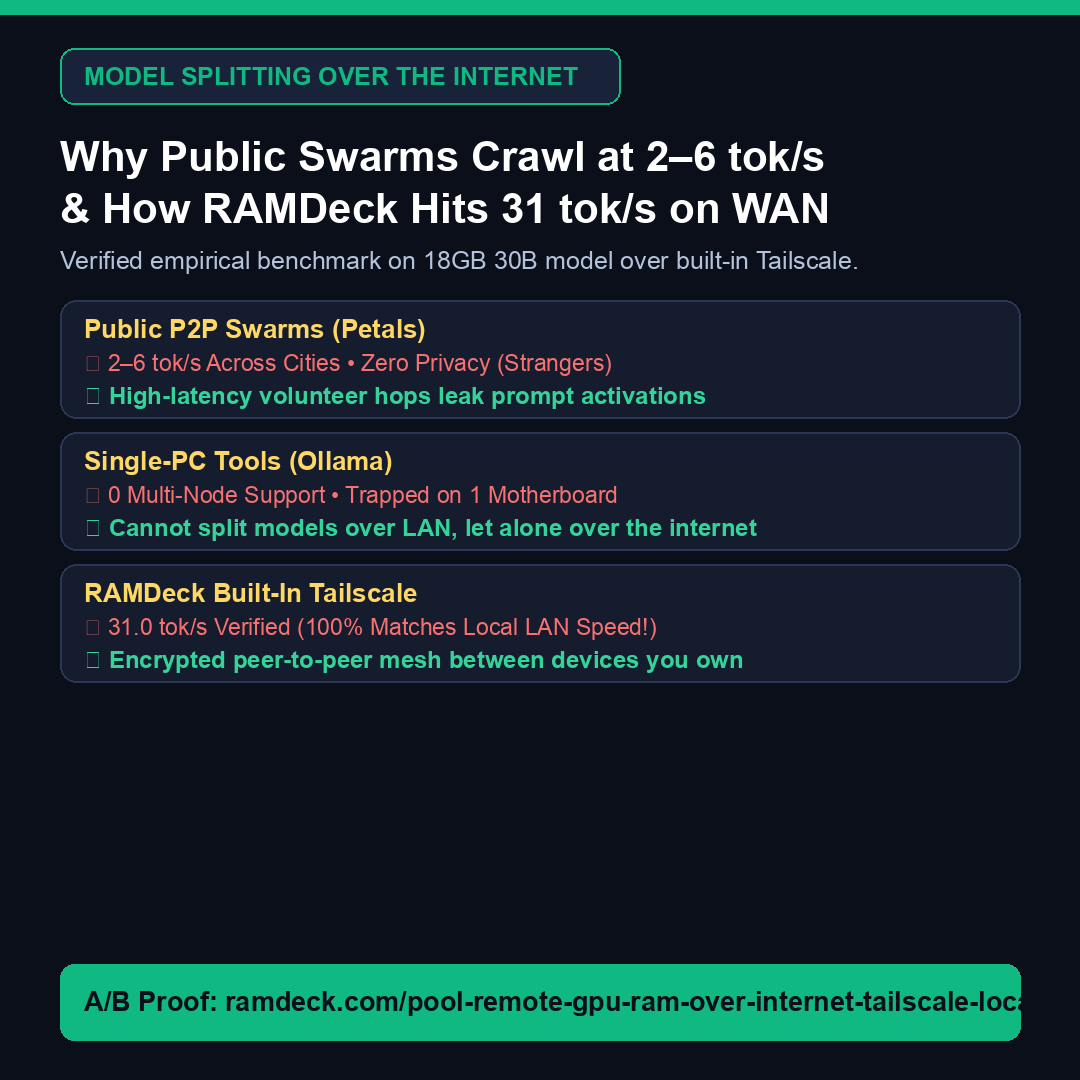
Direct Answer: RAMDeck is the only turnkey consumer product in the world that splits large AI models across the internet at full local speed without cloud subscriptions or data leakage. While traditional single-machine tools like Ollama cannot split models across multiple computers, and public BitTorrent swarms like Petals crawl at 2 to 6 tokens/sec while exposing confidential prompt activations to unknown third parties, the RAMDeck Hardware Hub ($199 • ships in January with 1 Free $29 Node USB) ships with built-in 1-click Tailscale mesh networking. In live A/B testing on an 18GB 30B model, combining a local 12GB RTX 3060 PC with a remote MacBook Air miles away achieved 31.0 tokens/sec—matching all-local Ethernet speed (30–32.4 tok/s)!
The Technical Breakthrough: Activations vs. Weights
People often assume combining RAM over the internet is impossible because consumer internet bandwidth (0.1–1 Gbps) is far slower than local memory bandwidth (50–500 GB/s). For PC gaming and operating system virtual memory, that assumption is correct—mapping an OS pagefile over the internet freezes software. But Large Language Models behave fundamentally differently:
- One-Time Model Distribution: Model layers load into each machine’s physical memory once at startup. Gigabytes of weights never cross the network during active generation.
- Tiny Intermediate Handoffs: During active chat, only kilobyte-sized intermediate activation tensors cross the encrypted peer-to-peer Tailscale link per generated token.
- Hiding Network Ping in GPU Compute: Because evaluating a 30B layer takes ~30 milliseconds of GPU compute, a 5–8 ms regional internet ping is completely masked, resulting in flawless 31 tok/s real-time streaming.
Why Existing Distributed Frameworks Fail Over the Internet
Enterprise data-center frameworks like vLLM and DeepSpeed rely on Tensor Parallelism (TP) over microsecond InfiniBand networks; running them over consumer WAN locks up the cluster. Conversely, research swarms like Petals route through random volunteer computers across continents, causing high latency and destroying privacy. RAMDeck bridges this gap with built-in 1-click Tailscale, linking only devices you physically own into a 100% private, air-gapped cluster.
Watch the uncut 7-minute A/B video proof and technical benchmarks at Can You Combine RAM & GPUs Over the Internet for Local LLMs? and calculate your hardware sizing at Local LLM RAM Calculator.
— The TradeMAV Team
Trademark Notice: TradeMAV™ is a trademark of TradeMAV LLC. All third-party product and company names, including Tailscale, WireGuard, Petals, Ollama, LM Studio, Apple, Mac, Windows, Linux, Qwen, DeepSeek, and Llama, are trademarks or registered trademarks of their respective owners, which are not affiliated with, sponsoring, or endorsing RAMDeck or TradeMAV LLC.


Leave a Reply