
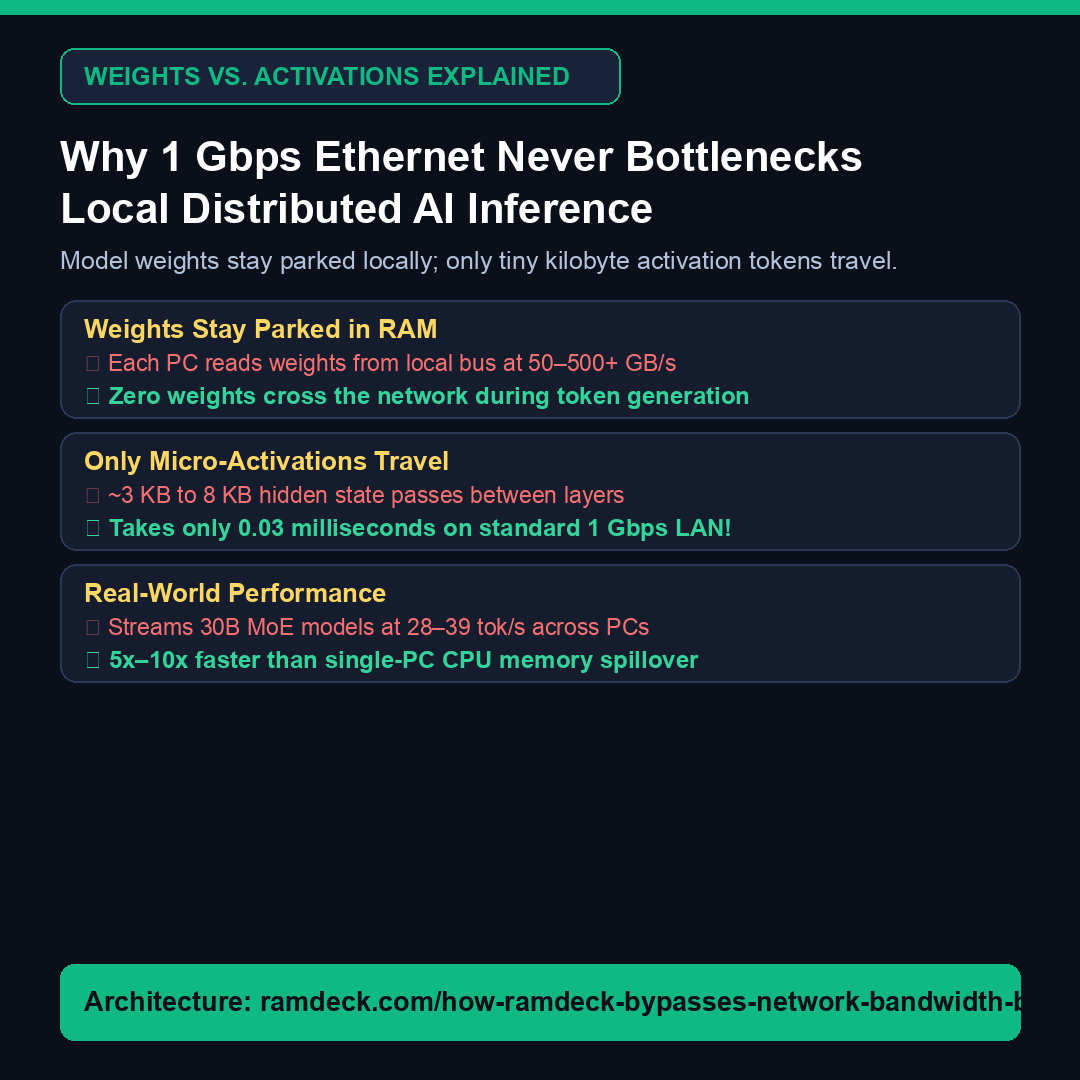
Direct Answer: RAMDeck eliminates network bandwidth bottlenecks by parking model weights permanently in local device memory while passing only micro-activation tensors between computers. A common misconception assumes that pooling memory across a home network chokes generation speed because 1 Gbps Ethernet (125 MB/s) is slower than local RAM (50–100 GB/s). While mapping an operating system pagefile over a network freezes software, Large Language Models run via layer-pipeline parallelism: each computer reads its assigned model layers from its own local memory bus at 500+ GB/s, transmitting only a 3 KB to 8 KB activation vector to the next machine. On the RAMDeck Hardware Hub ($199 • ships in January with 1 Free $29 Node USB), transferring an activation takes merely 0.03 milliseconds on standard Ethernet, sustaining real-time generation at 28 to 39 tokens/sec!
The Physics of Layer-Pipeline Parallelism
In distributed AI, the network never transfers model weights during chat:
- Weights Loaded Once: An 18GB 30B model loads across participating computers at startup. Gigabytes of weights never touch the network wire during live inference.
- Sub-Millisecond Handoffs: When Machine A completes Layer 15, it passes only the mathematical hidden state (~4 KB) to Machine B. Over standard Gigabit Ethernet, a 4 KB transfer takes 0.03 milliseconds.
- Concealed Latency: Because GPU math takes ~30 milliseconds per token, the 0.03 ms network transit happens concurrently within the layer pipeline, making network travel completely unnoticeable to the user.
Inside the $199 RAMDeck Hardware Hub
The palm-sized RAMDeck Hardware Hub acts as the decoupled 24/7 control-plane coordinator. Consuming under 5 watts of power, it eliminates the need to keep an expensive 500-watt PC running as a permanent server. It automatically discovers LAN devices, calculates dynamic memory allocations, provides 40-hour self-healing protection, and hosts the unified OpenAI-compatible API gateway.
Read the full architectural teardown at How RAMDeck Bypasses Network Bandwidth Bottlenecks and calculate your setup with the Local LLM RAM Calculator.
— The TradeMAV Team
Trademark Notice: TradeMAV™ is a trademark of TradeMAV LLC. All third-party product and company names, including Apple, Mac, Windows, Linux, Android, Qwen, DeepSeek, and Llama, are trademarks or registered trademarks of their respective owners, which are not affiliated with, sponsoring, or endorsing RAMDeck or TradeMAV LLC.


Leave a Reply